Shrink Yourself, Shrink Your Palette: The Gendered Psychology Behind Second-Guessing Bold Color
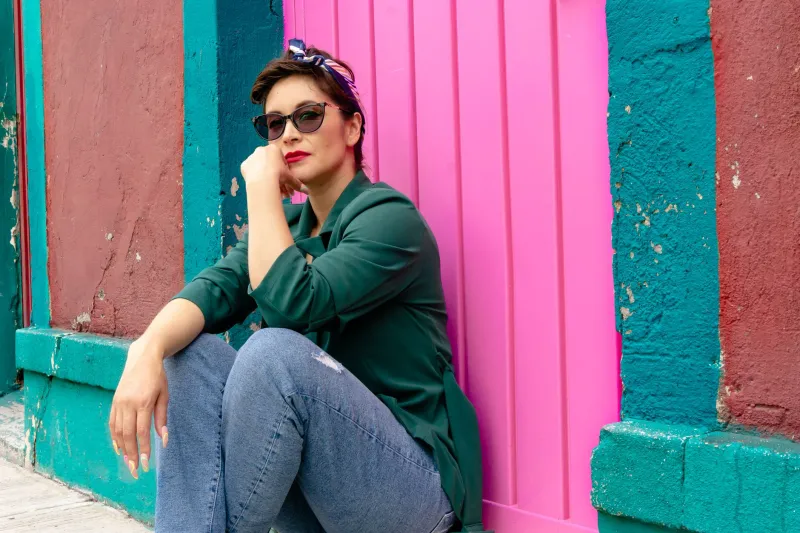
Let's start with a scene you've probably lived. You're getting dressed for something that matters — a big meeting, a first date, a dinner where you know you'll be photographed. You pull out the fuchsia wrap dress. You love it. You look incredible in it. And then, almost automatically, a small internal negotiation begins. Is it too much? Will people take me seriously? Should I just wear the navy?
Now ask yourself: have you ever watched a man have that conversation with himself about a bold-colored tie?
Right.
The gap between how women and men navigate color confidence isn't a personality quirk or a matter of individual taste. It's a pattern — one that's been documented, studied, and reinforced across decades of cultural messaging, workplace norms, and gendered socialization. And until we name it clearly, we'll keep mistaking a systemic problem for a personal one.
The Research Is Pretty Damning
Studies on color psychology and gender have consistently found that women experience significantly higher levels of social anxiety around wearing highly saturated, attention-drawing colors in professional and semi-professional contexts. A 2019 study published in Social Psychological and Personality Science found that women who wore visually prominent clothing in workplace settings were more likely to be perceived as seeking attention — and, crucially, that women themselves anticipated this judgment and pre-emptively dressed down to avoid it.
Men in the same studies? They didn't show the same anticipatory self-editing behavior. When a man walks into a room in a bold burgundy suit or a bright orange pocket square, the cultural script reads: confident, expressive, even creative. When a woman does the equivalent? The script flips. Suddenly it's about whether she's "trying too hard" or "dressing for attention."
Dr. Jennifer Baumgartner, a clinical psychologist and author of You Are What You Wear, has noted that women's clothing choices are far more socially policed than men's — and that this policing is so deeply internalized that women often can't distinguish between their own preferences and the rules they've absorbed. You think you don't like bold color. But do you actually not like it? Or have you just been told, in a thousand subtle ways, that it's not for you?
It Starts Way Before the Closet
Go back to girlhood for a second. From the time most of us could dress ourselves, we received a steady stream of feedback about visibility. Be ladylike. Don't be too loud. Don't show off. Don't take up too much space. These weren't always explicit instructions — sometimes they were a raised eyebrow from a grandmother, a comment from a teacher about your "very bright" outfit, a subtle frown from a parent when you reached for the red shoes instead of the white ones.
Boys, meanwhile, were largely left alone in this department. Their fashion choices were rarely read as personality statements requiring moderation.
Fast forward to adulthood, and those early lessons have calcified into something that feels like instinct. The hesitation before the bold piece isn't irrational — it's learned. It's the accumulated weight of being told, again and again, that female visibility requires justification.
Reader Marisol T., a 34-year-old marketing director in Chicago, put it this way: "I genuinely thought I was a 'neutral person' for most of my twenties. Then I started paying attention to why I reached for beige every morning. And I realized it wasn't preference — it was protection. I didn't want to be noticed for the wrong reasons at work. I didn't want to be the woman in the loud outfit."
The Professional Double Standard Nobody Talks About Enough
The workplace is where this gap becomes most visible and most costly. Women in corporate America have long navigated an exhausting paradox: dress too conservatively and you're overlooked; dress too expressively and you're not taken seriously. Bold color sits squarely in the danger zone of "too expressive" for many industries — despite the fact that color psychology research consistently shows that people who dress with intention and visual confidence are perceived as more competent and more decisive.
That disconnect exists because the standard for "professional" female dress was largely built around one goal: minimizing disruption. Don't distract. Don't provoke. Don't invite commentary on your appearance that might overshadow your work. The irony is that neutrals don't actually make women invisible — they just make them palatable. And palatable is not the same as powerful.
Reader Dominique W., a 41-year-old attorney in Atlanta, started wearing color deliberately after a mentor told her, early in her career, to "dress like the walls." "I spent eight years in gray and black," she said. "Then I watched a male colleague walk into a client meeting in a cobalt shirt and get complimented on his 'strong presence.' I wore cobalt the next week. Same reaction. I'd been playing by rules that weren't even real."
Breaking the Pattern Without Burning It All Down
Here's the thing: we're not telling you to show up to your most conservative client meeting in head-to-toe tangerine on Monday. That's not the point. The point is to start distinguishing between genuine style preferences and conditioned self-erasure — and to make choices from the former, not the latter.
A few places to start:
Notice the negotiation. When you catch yourself talking yourself out of a bold piece, pause. Ask whether the hesitation is coming from actual discomfort or from anticipated judgment. Those are different things, and they deserve different responses.
Start with one saturated piece per outfit. You don't have to go all in immediately. A single bold color in an otherwise simple look — a cobalt top with white trousers, a red bag against a neutral outfit — lets you build the muscle of being seen without feeling overexposed.
Audit the feedback you've internalized. Think back to specific moments when someone commented negatively on your bold clothing choices. Who was that person? What was their relationship to you? Was their opinion actually relevant to who you are now? A lot of us are still dressing to avoid the disapproval of people who haven't been in our lives for a decade.
Find your people. Visibility is a lot easier when it's normalized in your community. Follow fashion creators who wear color boldly and look like they're having a great time. Build a wardrobe alongside friends who hype you up rather than second-guess you.
Wear it before you feel ready. Confidence in bold dressing rarely comes before the act of bold dressing. It comes after. The dress doesn't wait for you to feel brave — you feel brave because you wore the dress.
Reclaiming the Obvious
Color is not a statement you have to earn. It's not a reward for a certain body type, a certain age, a certain level of professional achievement, or a certain level of not-caring-what-anyone-thinks. It is simply a tool — one that women have been quietly talked out of using for a very long time.
The confidence gap is real. But it's not inevitable. Every time you reach past the beige and grab the emerald, every time you walk into a room in something that makes you feel like yourself, you're doing something that matters more than it might seem. You're refusing, one outfit at a time, to take up less space than you deserve.
And that, honestly, is the boldest thing you can wear.